Coffee Shop Playlist Guide: How to Choose Background Music That Keeps Customers Coming Back
A coffee shop owner's guide to picking the right playlist: genres, tempo, volume, and licensing rules that shape how long customers stay and how much they spend.
Why Your Coffee Shop Playlist Matters More Than You Think
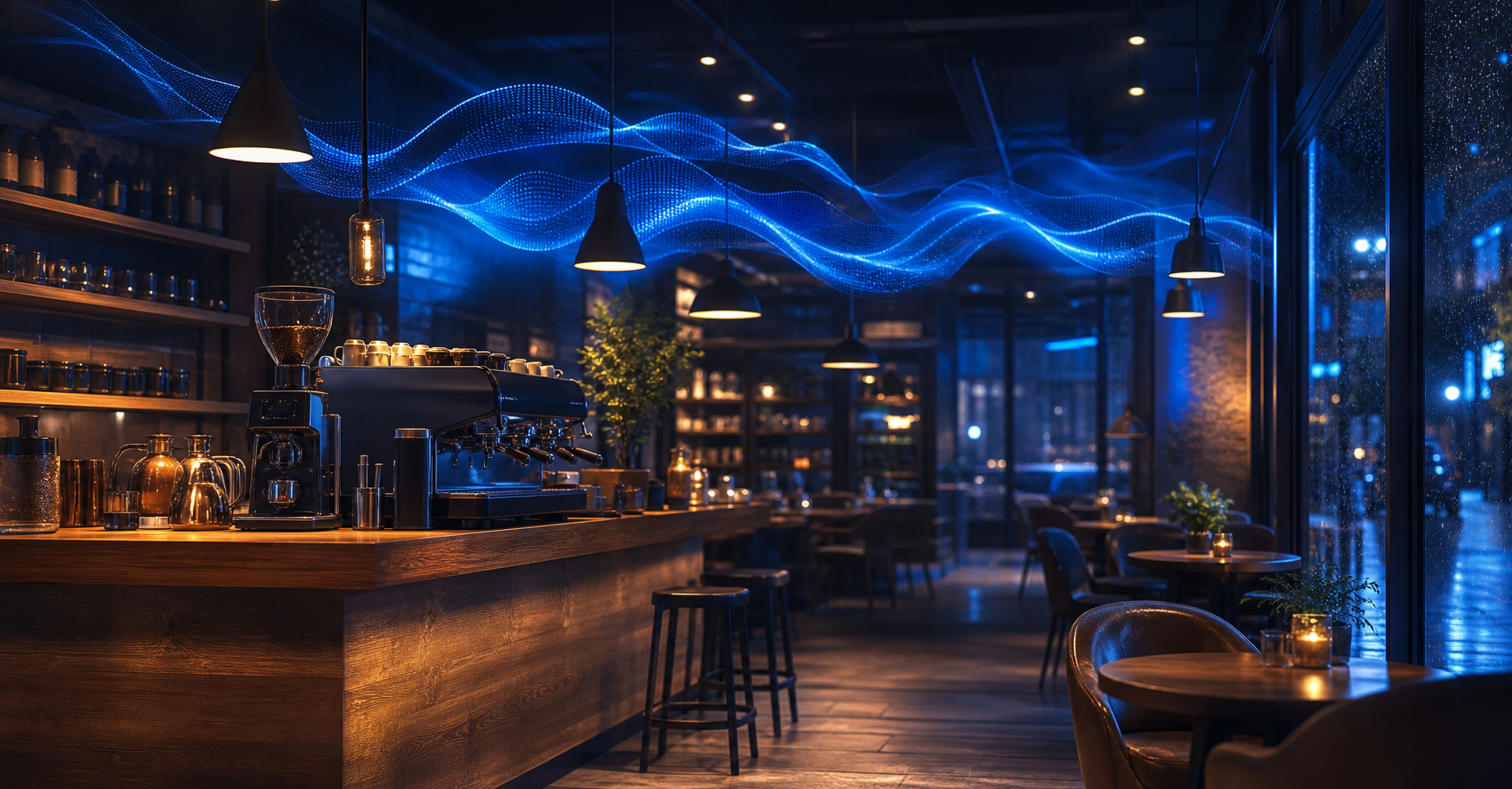
Walk into any coffee shop and the first thing you notice, often before the smell of espresso, is the sound. A coffee shop playlist is not background filler. It is a working part of the customer experience, right alongside the coffee itself, the lighting, and the seating.
Academic research backs this up. A study published by researchers at Oxford examined the effects of musical tempo on the coffee-drinking experience among 400 participants and found that tempo measurably shaped how customers perceived their time in the cafe (University of Oxford). More recent work published in the Journal of Marketing Analytics found that background music with the right tempo increased weekend customer dwell time and improved weekday purchase intentions in coffee retail settings (Springer, Journal of Marketing Analytics). Separate research on coffee shop atmospherics has also identified music, alongside aroma and lighting, as a core driver of customer satisfaction and the likelihood a customer returns (PMC, National Library of Medicine).
For an independent cafe or a growing chain, that means your playlist choices are a lever you can actually pull, not just a nice-to-have.
What Genre Should a Coffee Shop Play?
There is no single "correct" coffee shop genre, but a few categories consistently work across concepts:
- Acoustic and indie folk - warm, unobtrusive, pairs well with a community-focused, third-wave cafe vibe.
- Lo-fi and chillhop - popular with laptop-and-study crowds; low lyrical content keeps it from competing with conversation or focus work.
- Jazz and soul - fits a more upscale or classic cafe feel, especially in morning hours.
- Soft indie pop and alternative - good for afternoon energy shifts without becoming a bar-like atmosphere.
The genre should match your brand identity first. A minimalist specialty coffee bar and a cozy neighborhood cafe are selling two different feelings, and the music should reinforce whichever one you are actually selling (Sonos).
Tempo and Volume: The Two Dials That Matter Most
Tempo
Tempo is the most researched variable in background music studies, and it has a direct relationship with how long people stay and how quickly they move through a space. Research on tempo across food and beverage environments generally finds that slower tempo, in the 60-90 BPM range, is associated with longer dwell time, while faster tempo tends to speed up pace and shorten visits (QR8 Musical Solutions). Broader research on music and dining duration has similarly found that faster-tempo music can significantly decrease the amount of time customers linger (PMC, National Library of Medicine).
For coffee shops specifically, this creates a simple operating rule:
- Morning rush: slightly faster tempo (100-120 BPM) to support turnover and keep the line moving.
- Midday and afternoon: moderate tempo (80-100 BPM) for the laptop crowd and casual meetings.
- Slow hours and evening: slower tempo (60-90 BPM) to encourage customers to stay, order a second item, and relax.
Volume
Volume needs to sit low enough that two people can hold a normal conversation without raising their voices, and low enough that a customer on a laptop is not distracted. As a practical benchmark, most cafes aim for background-level volume, audible but never dominant, roughly the level of a quiet conversation happening two tables away. If your barista has to repeat an order back twice because the customer couldn't hear over the music, the volume is too high.
Matching Music to Time of Day
A coffee shop playlist should not be static. The best-run cafes program music in blocks:
- 6-9 a.m.: Upbeat but not jarring. Something to wake people up without feeling aggressive.
- 9 a.m.-2 p.m.: Calmer, focus-friendly. This is when laptop workers and meetings dominate.
- 2-5 p.m.: A gentle lift in energy for the afternoon slump.
- 5 p.m. close (if applicable): Warmer, slower, more relaxed tones as the day winds down.
This kind of segmented approach is standard practice in commercial audio branding and mirrors how tempo-based programming is used across retail and hospitality more broadly (Sound Machine).
The Legal Side: Can You Just Play Spotify?
This is one of the most common and most costly mistakes coffee shop owners make. A personal Spotify, Apple Music, or Pandora account is licensed for private, non-commercial listening only. Playing it in a business that is open to the public, even quietly in the background, is considered a public performance of copyrighted music and requires separate commercial licensing.
In the United States, the organizations that handle these rights are performing rights organizations, or PROs, including ASCAP, BMI, SESAC, and GMR. Guidance from the Texas Governor's office on music licensing for businesses confirms that venues generally need licenses from these PROs to legally play copyrighted recorded music (Texas Governor's Office). Spotify's own community guidance likewise states that a business needs a commercial license, such as Spotify Business, rather than a personal account, if music is playing in a public establishment (Spotify Community).
Cafes that skip proper licensing risk cease-and-desist letters, fines, and in some cases lawsuits from PROs actively monitoring venues. The simplest way to stay compliant is to use a commercial background music service built for business use, which bundles the licensing into the subscription so you never have to track it yourself.
Building a Playlist That Reflects Your Brand
Beyond genre and tempo, the strongest coffee shop playlists share a few traits:
- Consistency: the same overall mood and quality level every visit, so regulars know what to expect.
- Low repetition: a large enough rotation that staff and regulars are not hearing the same 20 songs on loop.
- No jarring transitions: smooth shifts between songs and time-of-day blocks, not sudden genre whiplash.
- Local flavor, when it fits: some cafes weave in local artists or genre choices tied to their neighborhood identity.
Get this right and music becomes part of what makes your cafe recognizable, the same way your logo or your cup design is.
A Simpler Way to Get It Right
Building and maintaining a licensed, time-of-day-aware playlist by hand is a lot to manage on top of running a cafe. That is exactly the gap BizRadioStation was built to close. BizRadioStation creates a custom branded radio station for your coffee shop, complete with fully licensed music curated to your brand, tempo programming that adjusts through the day, and optional custom jingles or promo drops that reinforce your identity, all running on AutoDJ so it plays correctly every single day without anyone touching a laptop.
If you are ready to stop worrying about licensing risk and start using music as a real part of your customer experience, see how BizRadioStation can build a custom station for your coffee shop.